The question behind most new-opener calls in Amarillo is not brand, it is drive type. Here is what each one does, where the quiet belt earns its keep, and what a proper installation visit covers. Free estimate.
Tell us what the door is doing. The estimate is free and you can say no.
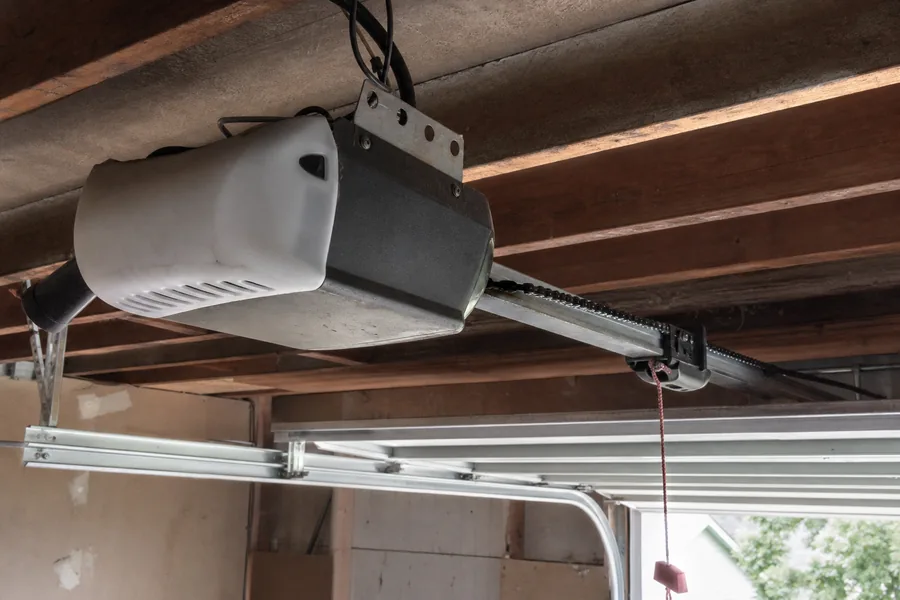
Every residential opener is a motor at the back of the garage moving a trolley along a rail; the trolley is tied to the top of the door by an arm. The drive type is only the thing that connects motor to trolley. A chain drive uses a bicycle-style chain. A belt drive uses a steel-reinforced rubber belt. A screw drive turns a long threaded rod. A direct drive, the least common, puts the motor on the trolley itself and runs it along a fixed chain. The door does not care which; the people in the house do.
In Amarillo the split we see is roughly this: chain drives in garages built or re-equipped before about 2012, belts in most of what has gone in since, and screw drives on a handful of older houses in Wolflin and Canyon. All three can be running fine at fifteen years old. The reason to change one is rarely that it died; it is that the household finally got tired of hearing it.
For a detached garage nobody sleeps next to, a chain drive is still a perfectly good answer. For anything attached to the house, we put in belts almost every time.
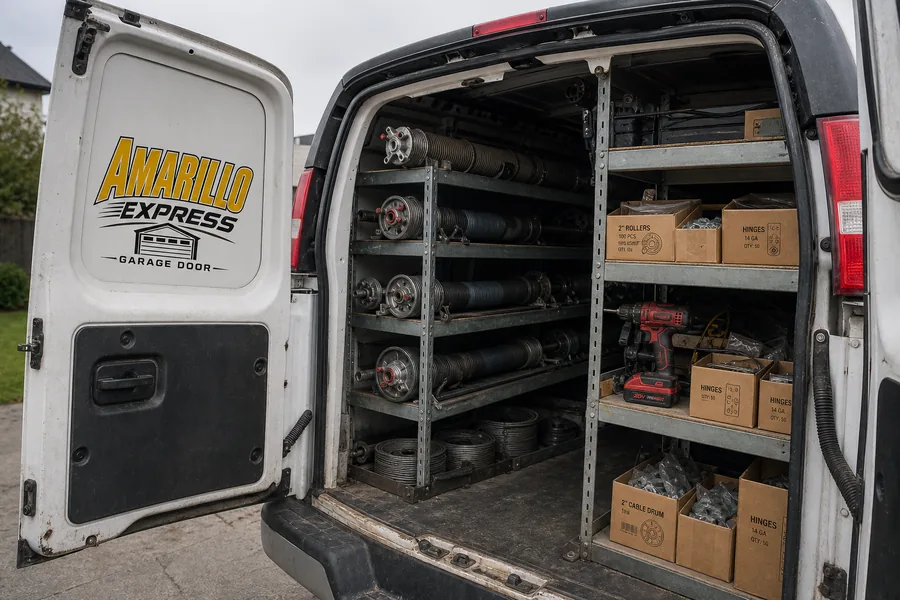
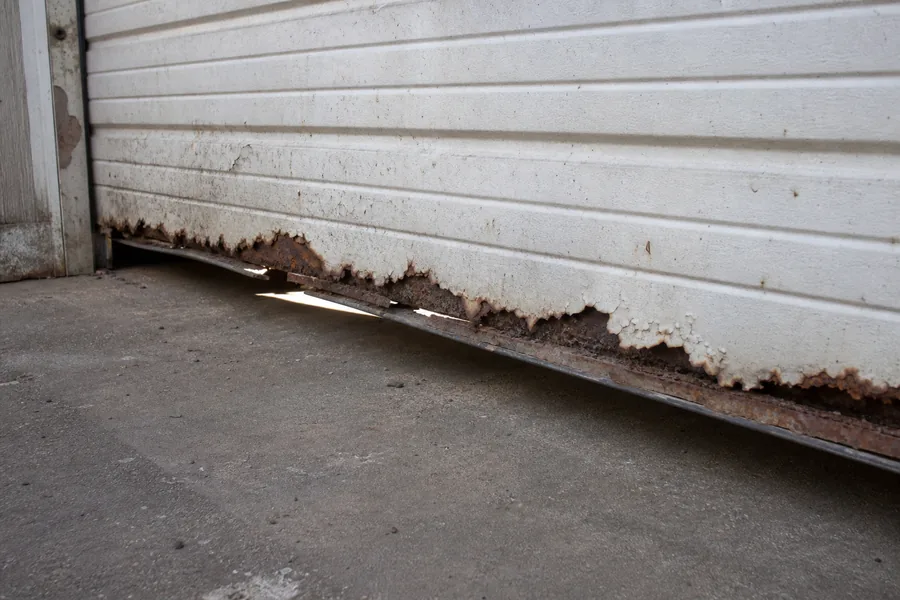
In order, on every new-opener call.
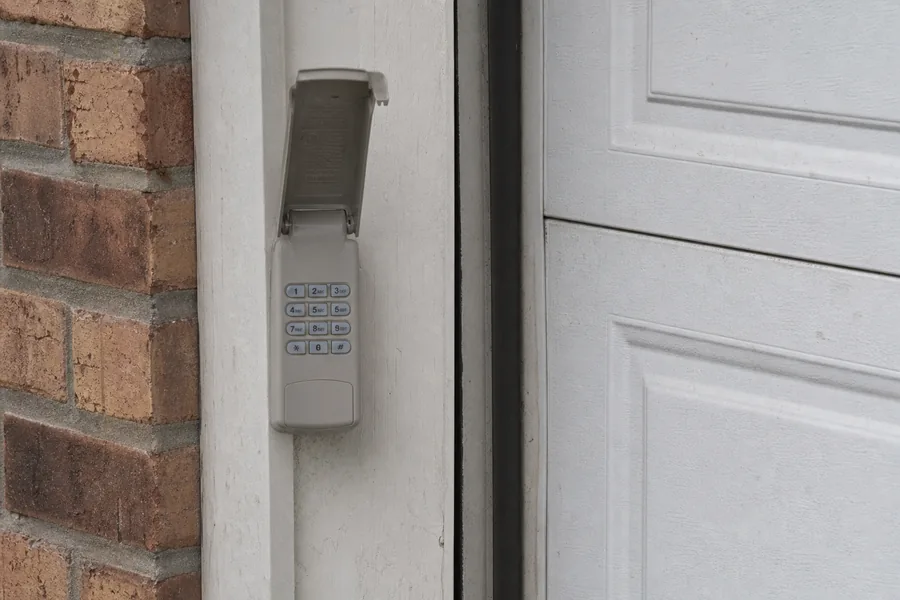
The current LiftMaster, Chamberlain and Genie ranges have Wi-Fi built in: the door shows on your phone, closes itself if it was left open, and lets a delivery in while you are out. It is useful in a household where someone always wonders whether the door was shut. It is not something to pay for again through a monthly plan when the basic app does what most people need.
Battery backup is the extra we recommend most. Storm outages are when a door is most likely to be needed, and a backup keeps the opener running for a day or so. Some jurisdictions now require it on new installations. The Genie Signature Series and the LiftMaster belt units have it on board or as a clip-in module.
The name people arrive with this month is the Genie Signature Series: a three-quarter horsepower belt drive with the quiet motor, battery backup and Wi-Fi in one unit. It is a solid choice for a double door. LiftMaster's belt units sit in the same place, with the myQ app and, on the top models, an integrated camera and a wall-mounted jackshaft version for garages with no room above the door. Chamberlain is the same company as LiftMaster in retail packaging.
Horsepower ratings are mostly marketing. A half-horsepower unit lifts a balanced single door for twenty years; three-quarter suits a double or an insulated door; anything above that is for oversized or wood doors. What matters more is that the springs are doing the lifting so the motor only has to guide.
Half the new-opener calls we take across Potter County do not need a new opener. The unit is straining because a spring has weakened, a cable has jumped its drum, or the rollers have seized, and the opener is the loudest thing complaining about it. Replace the opener and the problem comes back with the new one. The technician lifts the door by hand first, and if the door is the problem you hear that, with a free estimate for the real fix.
Free estimate. You hear what the door needs and what the opener would be before anything is decided, and no is a complete answer.
Belt drives can't lift heavy doors. Current belts are steel-reinforced and rated for double and insulated doors. The limit is the springs, not the belt.
A bigger motor fixes a struggling opener. No. A struggling opener means an unbalanced door. The bigger motor strains a little longer and then fails the same way.
Smart openers need a subscription. The basic app on LiftMaster, Chamberlain and Genie units is free. Paid plans add video storage and delivery features most households never use.
You can keep the old rail. Not across brands, and rarely within one. A new opener comes with its rail and we hang the whole assembly.
Yes, and the difference is largest in the room directly above or beside the garage. Chain drives rattle the rail; a belt hums.
Nearly always, once the door is balanced. The technician checks the springs and the hardware first; an opener goes on a door that lifts by hand easily.
Most of an afternoon, including programming every remote and car and testing the safety reverse.
Only when there is no room over the door for a rail: a lift, storage racks, or a very low ceiling. The LiftMaster jackshaft unit hangs beside the door and drives the torsion shaft directly.
Free, across Potter County. You hear what the door needs and which opener fits before anything is decided.
Often, and an opener that has quit is treated as an emergency because the car is inside.
Around Wolflin and Canyon, Bushland, one call gets you a two-hour slot and a heads-up call before the technician sets off. Nobody on a phone judges a door they can't see.
Free estimate. Throughout Potter County, including Wolflin, Puckett, Southwest Amarillo, Canyon, Bushland, Borger.
Two hours, not a day, and you'll get a call as the technician sets off. Free throughout Potter County. The estimate is free either way.
Prefer to talk it through? Call (806) 545-9374.
Tell us what the door is doing. The estimate is free and you can say no.