
On brick ranches the garage is often the way into the house. Here's the list we hand people after a break-in on the block, most of it an afternoon's work.
Tell us what the door is doing. The estimate is free and you can say no.
A garage door is several small weaknesses stacked up: a reachable release, a code that never changed, a remote in a car on the street, glass in the panels, a side door with a knob lock, and an unlocked door into the house. None is serious alone. Together they explain why break-ins around Amarillo so often start in the garage.
The list is short, mostly free, and the hardware parts are quick to install.
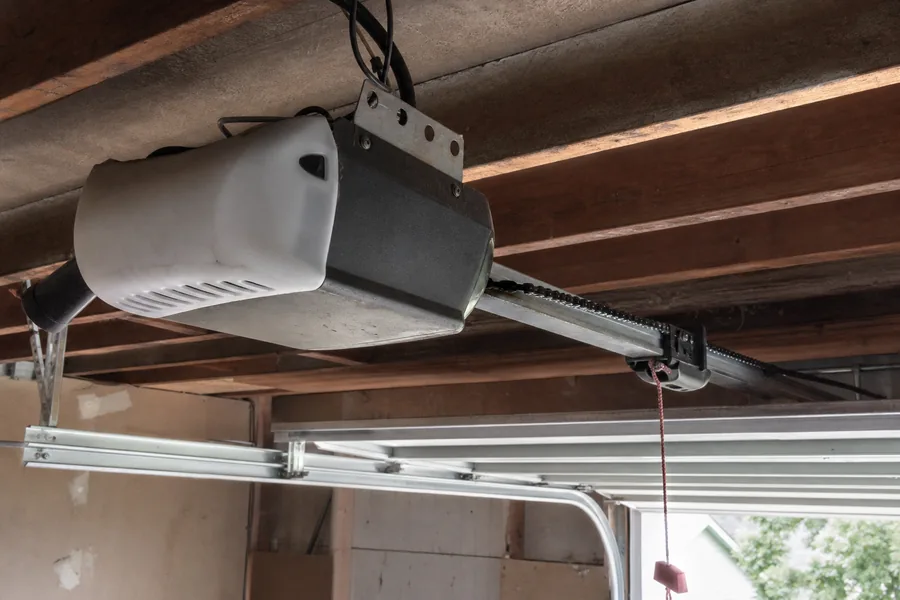
The red cord hanging from the opener trolley disconnects the door from the opener so it can be lifted by hand in a power cut. It has to stay reachable from inside; that's a safety requirement. What it doesn't have to be is reachable from outside, and on many doors the gap at the top of the door leaves it exposed.
The answer is a shield over the trolley. It stops the cord being reached from outside and changes nothing about pulling it from inside. It's a ten-minute install and we carry them.
Free ones first, then the hardware.

Rolling code (late 1990s onward) changes the signal on every press. Fixed code (older) doesn't, and can be duplicated. If yours is fixed-code, replacement is the honest recommendation: security, lock mode, alerts and less noise in one visit.
You can tell by the learn button. A colored square button on a Chamberlain or LiftMaster, or a Genie marked Intellicode, is rolling code. A row of small switches inside the remote's battery cover is fixed code.
The trip checklist: opener lock mode, track slide lock, remotes out of the car, inside door deadbolted, app alerts on, a neighbor told. It takes less time than packing.
Back home, unlock the slide bolt before the opener runs; it can't lift a locked door and will hurt itself trying.
Shields, slide locks, deadbolts, windowless top sections, smart openers and modules, and replacements for fixed-code units. All standard work around Amarillo, and something we'll walk through on any other visit if you ask.
What we don't do is describe on this site how a garage door is defeated. The protections above are enough to know; the methods aren't something we publish.
A closed garage door is a secured garage door. Not if the release is reachable, the remote is in the car and the inside door is unlocked. Closed and secured are different states.
Smart openers make it less secure. A current one with a strong account password is the opposite: you find out the moment the door opens, and you can shut it from a phone. The risk is a weak password reused from somewhere else.
The side door doesn't matter. It's the door most often used, because it's the one nobody hardened.
Yes. It blocks the release from outside and above only. From inside the garage the cord hangs and pulls as it always did.
If the remote has a row of small switches under the battery cover, it's fixed code and we'd recommend replacing the opener. If it has a learn button, it's rolling code and fine to keep.
Yes, on most sectional doors. It fits inside the track and takes about twenty minutes. Remember to unlock it before using the opener.
It looks like frosted glass from outside and lets light in. If you'd rather, a replacement top section with no windows matches the rest of the door.
Free, across Potter County. You hear what we'd suggest and what it takes, and no is a complete answer.
Nearly always; these are short jobs.
Around Wolflin and Canyon, Bushland, one call gets you a two-hour slot and a heads-up call before the technician sets off. Nobody on a phone judges a door they can't see.
Free estimate. Throughout Potter County, including Wolflin, Puckett, Southwest Amarillo, Canyon, Bushland, Borger.
Two hours, not a day, and you'll get a call as the technician sets off. Free throughout Potter County. The estimate is free either way.
Prefer to talk it through? Call (806) 545-9374.
Tell us what the door is doing. The estimate is free and you can say no.